A new book by S.B.G. Domah
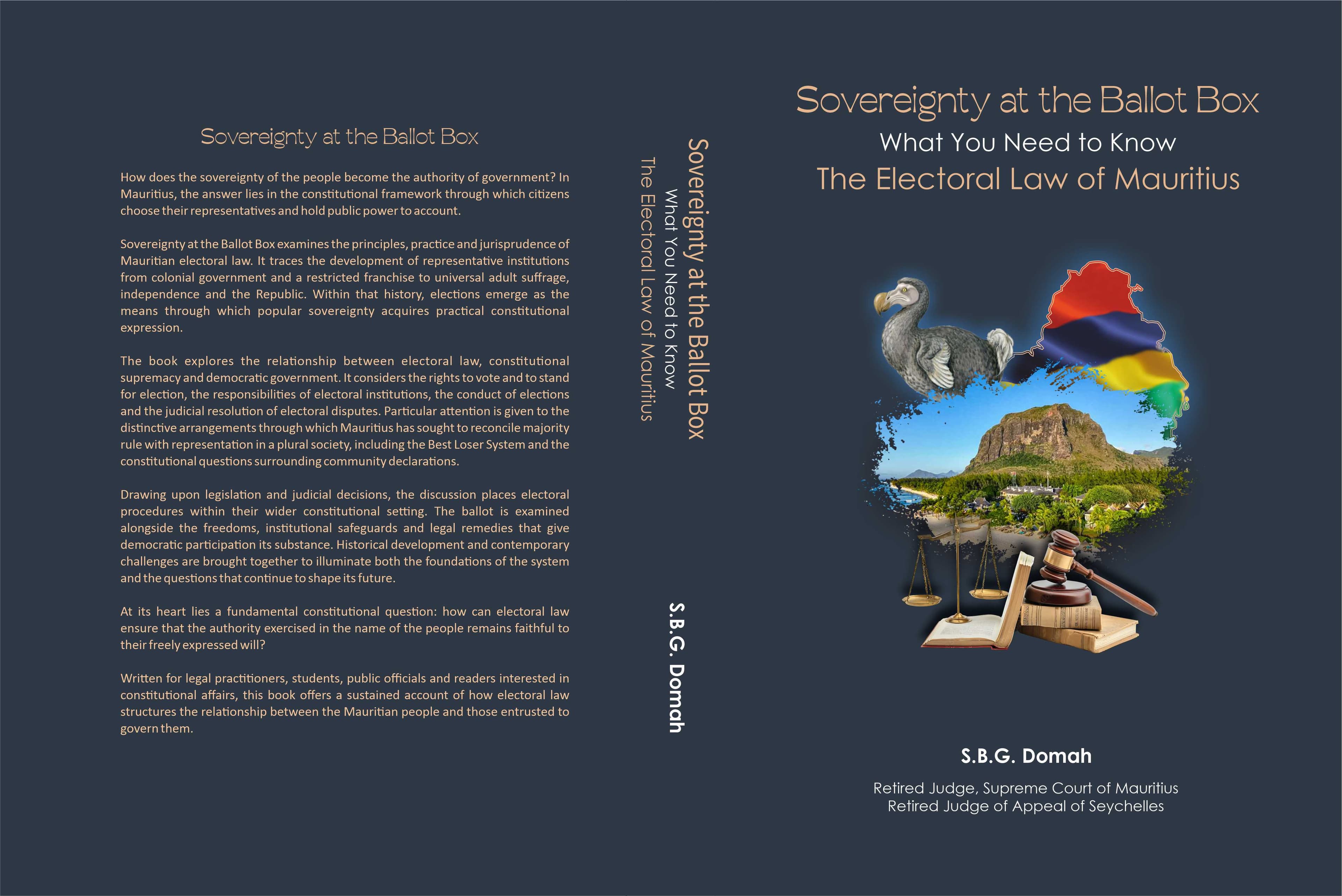
Sovereigntyat the Ballot Box
What You Need to Know:The Electoral Law of Mauritius
How does the sovereignty of the people become the authority of government? In Mauritius, the answer lies in the constitutional framework through which citizens choose their representatives and hold public power to account.
- Author
- S.B.G. Domah, Retired Judge, Supreme Court of Mauritius
- Subject
- Electoral and constitutional law of Mauritius
- Inside
- 20 chapters, from colonial government to the future of the system
The book
Electoral law is more than the law of elections.
What does the sovereignty of the people mean in the constitutional democracy of Mauritius? Sovereignty at the Ballot Box examines this question through the law, jurisprudence and doctrine that give electoral democracy its substance.
Particular attention is given to the Best Loser System and community declarations within the plural society of Mauritius. Drawing upon legislation and judicial decisions, the book places familiar electoral controversies within their legal framework. Its central concern is how authority exercised in the name of the people can remain faithful to their freely expressed will.
- 01From colony to Republic
- How representative institutions grew from colonial government and a restricted franchise to universal adult suffrage, independence and the Republic.
- 02The right to vote and to stand
- Electoral law read alongside constitutional supremacy, and the responsibilities of the institutions that run elections.
- 03Conduct and disputes
- The campaign, poll day and the count, electoral offences, and the judicial resolution of electoral disputes.
- 04The Best Loser System
- Community declarations and minority representation within the plural society of Mauritius, and the questions about its future.
The questions
A democratic autopsy is long overdue.
Are we enhancing our democratic heritage or squandering it?
Has our emphasis on representative government adequately addressed responsible government?
Have our assessments of the Best Loser System been sound?
Should a homogeneous conception of democracy dictate our electoral arrangements?
What does it mean to be Mauritian?
Is our heterogeneity, inspired by four civilisations embedded in our nationhood, our distinguishing mark and potential?
How does the Best Loser System relate to minority rights, and how should its peripheral problem be resolved?
From the back cover
“Hard-earned sovereignty, once exercised at the ballot box, remains with the people throughout the mandate. It is not surrendered until the next election.”
Contents
20 chapters on how Mauritius chooses who governs.
Chapter 1
The Emergence and Evolution of Parliamentary Democracy in Mauritius
Chapter 2
From the Divine Right of Kings to…
Chapter 3
Ensuring a Free and Fair Election
Chapter 4
Legitimacy, Peremptory Norms and the Foundations of Electoral Law
Chapter 5
The Delimitation of Electoral Boundaries
Chapter 6
The Elector Franchise Registration and conduct
And 14 more, through to the future of the electoral system.
Who it is for
Democracy is the responsibility of one and all.
Citizens
A basis for understanding their continuing role.
Parliamentarians
A reminder of their civic vocation.
Electoral bodies and officials
Grounds for vigilance.
Constitutional lawyers and academics
Material for further enquiry.
Students
A deeper appreciation of universal suffrage and its significance.
Reserve your copy