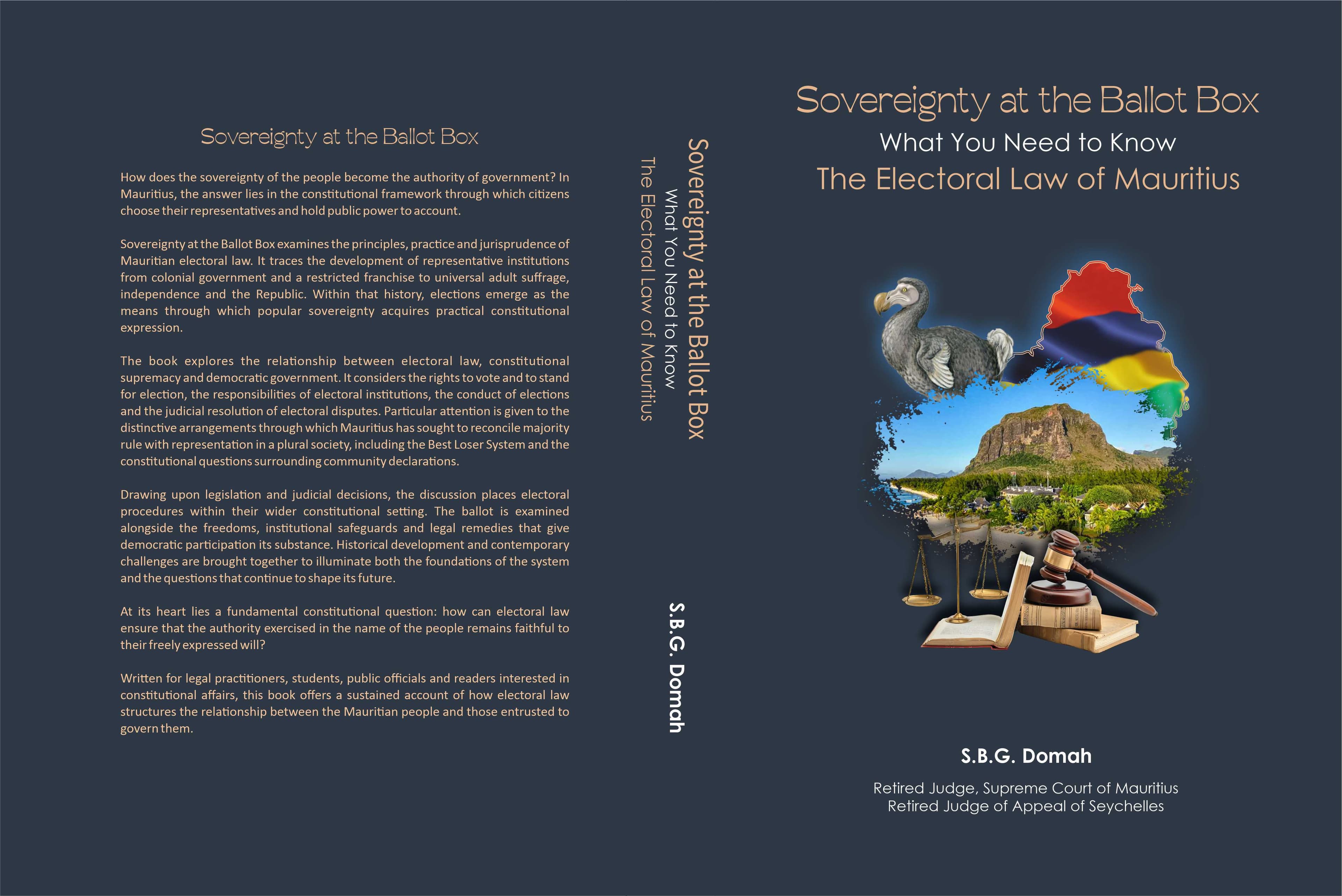
The book
What does the sovereignty of the people mean?
- Title
- Sovereignty at the Ballot Box
- Subtitle
- What You Need to Know: The Electoral Law of Mauritius
- Author
- S.B.G. Domah
- Chapters
- 20
Inside the book
The law that gives democracy its substance.
What does the sovereignty of the people mean in the constitutional democracy of Mauritius? Sovereignty at the Ballot Box examines this question through the law, jurisprudence and doctrine that give electoral democracy its substance.
Beginning with the travaux préparatoires that shaped the electoral system, the book traces the development of representative institutions from colonial government to universal adult suffrage, independence and the Republic. It connects electoral law with constitutional supremacy, examining the rights to vote and to stand for election, the responsibilities of electoral institutions, the conduct of elections and the judicial resolution of electoral disputes.
Particular attention is given to the Best Loser System and community declarations within the plural society of Mauritius. Drawing upon legislation and judicial decisions, the book places familiar electoral controversies within their legal framework. Its central concern is how authority exercised in the name of the people can remain faithful to their freely expressed will.
Beyond polling day
Sovereignty does not end when the votes are counted.
The will of the people is expressed through secret votes at the ballot box. But sovereignty does not end when the votes are counted. Meaningful consultation and accountability throughout the mandate remain essential to democratic government.
Sovereignty at the Ballot Box invites readers to consider whether Mauritius is living its democratic heritage or abdicating it. It addresses a gap in public understanding of how electoral law sustains democracy and how constitutional freedoms, institutional safeguards and legal remedies protect participation beyond polling day.
Democracy is the responsibility of one and all. The book speaks to each of those who share it:
- Citizens
- A basis for understanding their continuing role.
- Parliamentarians
- A reminder of their civic vocation.
- Electoral bodies and officials
- Grounds for vigilance.
- Constitutional lawyers and academics
- Material for further enquiry.
- Students
- A deeper appreciation of universal suffrage and its significance.
From the back cover
“Hard-earned sovereignty, once exercised at the ballot box, remains with the people throughout the mandate. It is not surrendered until the next election.”
From the back cover
Is sovereignty being lived, or abdicated?
Sovereignty at the Ballot Box challenges assumptions held for nearly half a century in public discussions, commission reports, academic studies and political party comments on the electoral system of Mauritius. Electoral law is more than the law of elections. It reaches the roots of democratic government based on the rule of law. Sovereignty belongs to the people, and to no other person or body. They decide who must govern them, but their sovereignty extends beyond the ballot box.
The gap in public understanding of that sovereignty is disquieting. Democracy does not end with the formation of government. The people retain their power to ensure that government fulfils its mandate, to assist it in good governance and to hold it to account. Sovereignty is not abdicated.
As Mauritius approaches its sixtieth anniversary of independence, a democratic autopsy is long overdue.
- Are we enhancing our democratic heritage or squandering it?
- Has our emphasis on representative government adequately addressed responsible government?
- Have our assessments of the Best Loser System been sound?
- Should a homogeneous conception of democracy dictate our electoral arrangements?
- What does it mean to be Mauritian?
- Is our heterogeneity, inspired by four civilisations embedded in our nationhood, our distinguishing mark and potential?
- How does the Best Loser System relate to minority rights, and how should its peripheral problem be resolved?
The book compels readers to examine these questions for themselves. Universal suffrage, concretised in the Representation of the People Act 1958, marked the transition from colonial sovereignty to the sovereignty of the people. Upon that foundation rests our constitutional democracy, sustained by institutions, processes and procedures designed to secure orderly, credible elections and renewed mandates for peace, order and good government.
Offering an authoritative guide through electoral controversies, this book is dedicated to those whose voices matter but who are sidelined after elections. Governments, academics, practitioners, parliamentarians, electoral bodies, officials and students will find material to inform their responsibilities, deepen their understanding and strengthen their democratic heritage.
It is in the interest of nobody that a democratic electoral system produces an autocratic government. Democracy is the continuing responsibility of all who exercise, administer or scrutinise public power. Hard-earned sovereignty, once exercised at the ballot box, remains with the people throughout the mandate. It is not surrendered until the next election.
The jacket
Front, spine and back.
Reserve your copy